
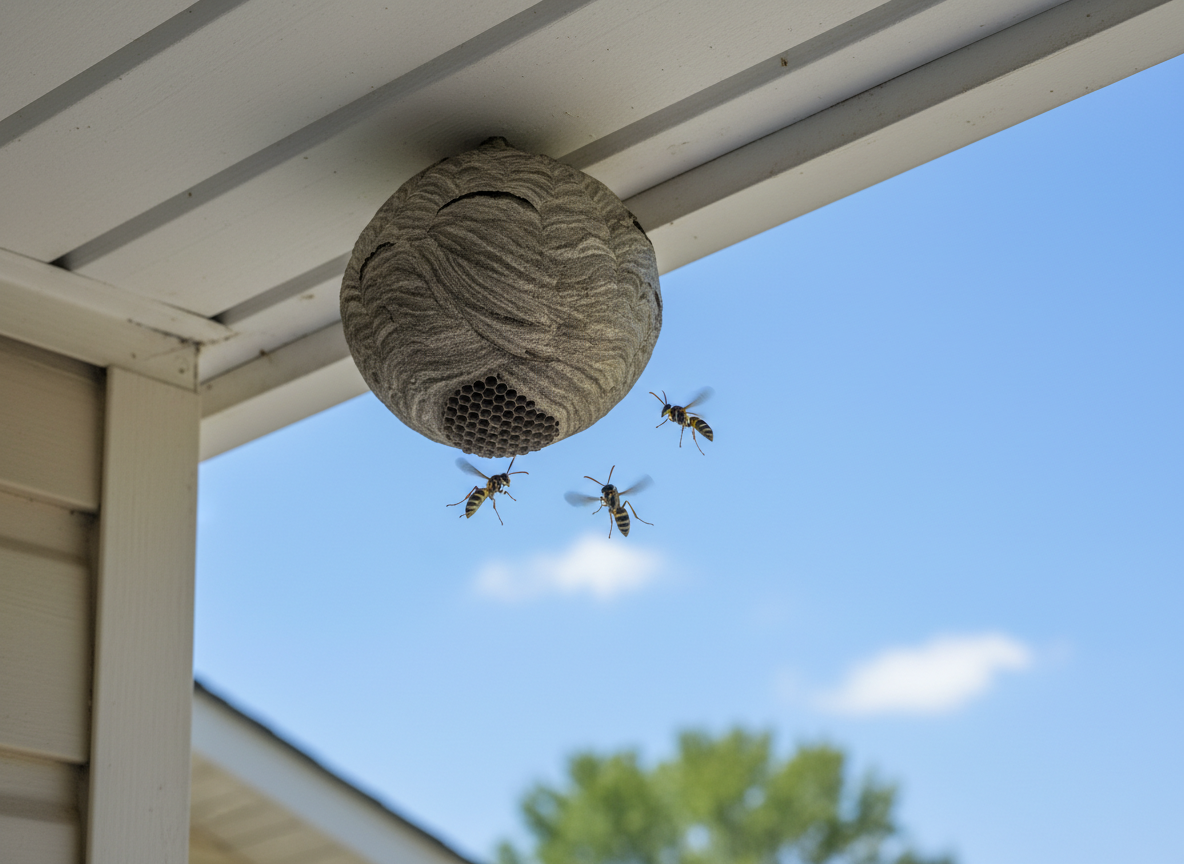
Every summer, homeowners across Durham Region find wasp nests in the same places: under decks, inside shed corners, behind siding, and up in the eaves. Some nests can be left alone, but many are too close to where people and pets spend time. Here’s how to decide what to do.
Know what you’re dealing with
- Paper wasps build open, umbrella-shaped nests under eaves and railings. They’re usually less aggressive.
- Yellow jackets often nest in the ground, under decks, or inside wall voids. They’re the ones most likely to sting.
- Bald-faced hornets build large, grey, football-shaped nests in trees and shrubs, and defend them aggressively.
Why late summer is the riskiest time
Nests start small in spring and keep growing all summer. By late August and September, colonies are at their largest and natural food sources are running out, so wasps become far more defensive around decks, patios and garbage bins.
When to call a professional
- The nest is near a door, deck, play area, or walkway
- Anyone in the home is allergic to stings
- Wasps are going in and out of a wall, soffit, or the ground and you can’t see the nest
- The nest is high up and would need a ladder to reach
Why DIY sprays often backfire
Store-bought sprays often don’t reach the centre of the nest, especially one hidden under a deck or inside a wall. A partial hit can set off a defensive swarm, and working from a ladder while being stung is a real fall risk. Professional removal uses protective gear and is timed for when the colony is least active.
Learn more about our wasp and hornet control in Durham Region, or book an inspection. First-time customers save 10%.

